
Table of Contents
- Overview
- Why NIST and COBIT Get Confused
- What NIST Really Does
- What COBIT Really Does
- Side-by-Side Comparison
- How Both Frameworks Apply in Real IT Environments
- Practical Example Using a Generic Infrastructure
- Which One Should You Start With?
- Conclusion
1. Overview
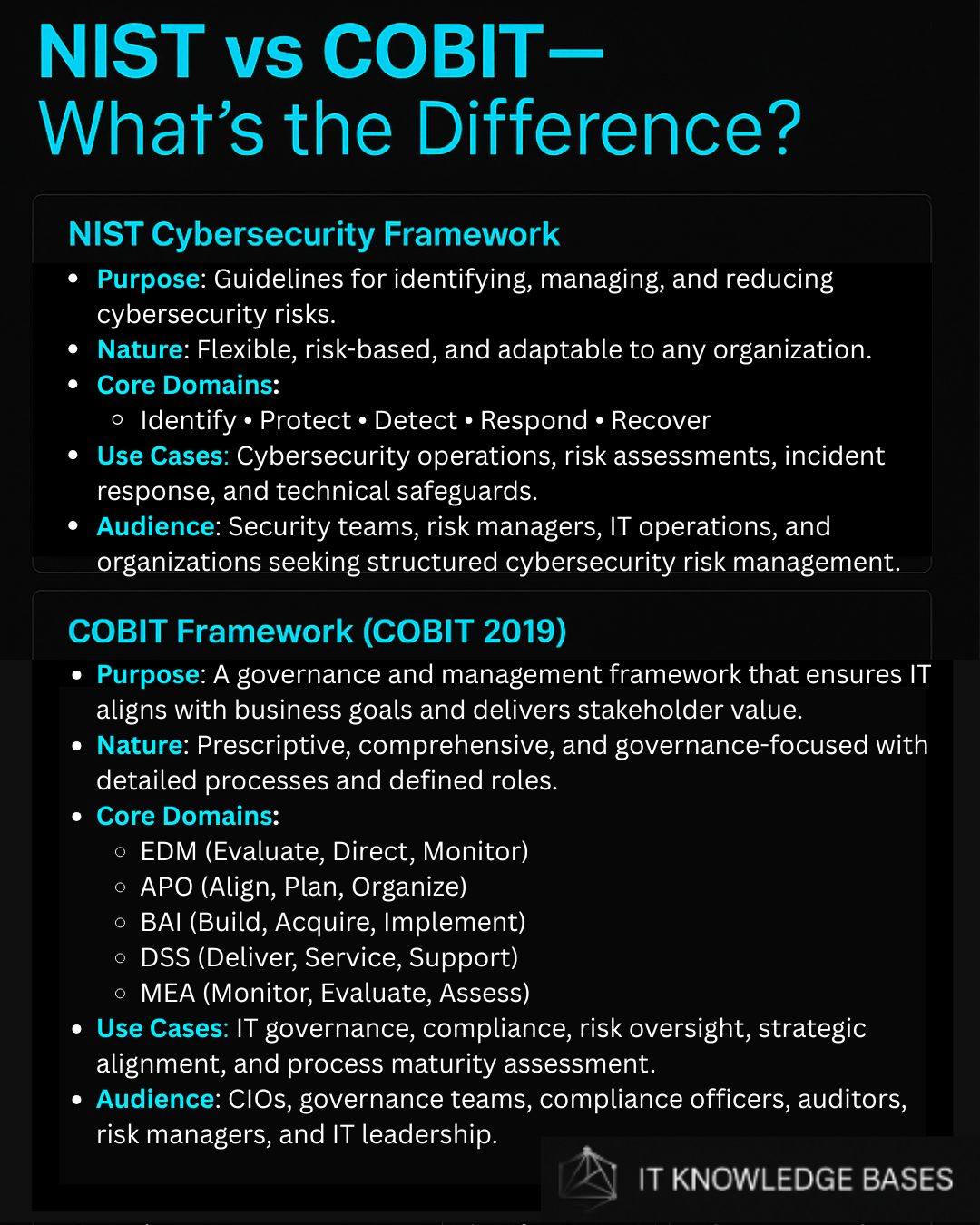
NIST CSF and COBIT 2019 are two widely referenced frameworks in cybersecurity and IT governance. Many IT professionals understand pieces of each but struggle with how they differ in practice. One is focused on cybersecurity risk; the other is focused on governance and accountability.
This blog breaks down their roles, differences, and how to practically apply each framework in a real organization.
2. Why NIST and COBIT Get Confused
The confusion comes from overlap, but their purposes are different:
- NIST CSF: Helps teams identify threats, implement controls, and reduce cybersecurity risk.
- COBIT: Ensures IT is aligned with business objectives, has defined roles, and follows structured processes.
NIST is tactical. COBIT is strategic.
3. What NIST Really Does
NIST CSF focuses on operational cybersecurity. Its lifecycle can be summarized as:
Identify → Protect → Detect → Respond → Recover
NIST Covers:
- Asset inventory and classification
- Vulnerability management
- Security controls and technical safeguards
- Security monitoring and SIEM usage
- Incident response and containment procedures
- Backup and recovery expectations
NIST is hands-on and focused on improving security posture.
4. What COBIT Really Does
COBIT 2019 is about governance and ensuring IT supports business needs. It is not a technical framework—it defines roles, ownership, structure, and measurement.
COBIT Domains:
EDM – Evaluate, Direct, Monitor
APO – Align, Plan, Organize
BAI – Build, Acquire, Implement
DSS – Deliver, Service, Support
MEA – Monitor, Evaluate, Assess
COBIT Covers:
- Who owns IT processes
- How decisions are approved
- How risks are accepted or escalated
- Strategy alignment and governance reporting
- Maturity assessment and accountability
5. Side-by-Side Comparison
| Category | NIST CSF | COBIT 2019 |
|---|---|---|
| Purpose | Cybersecurity risk management | IT governance and strategic alignment |
| Scope | Security and resilience | Full IT lifecycle |
| Nature | Flexible and adaptable | Structured and prescriptive |
| Audience | Security & IT operations | CIOs, auditors, governance teams |
| Outputs | Controls, safeguards, incident response | Roles, metrics, policies, processes |
6. How Both Frameworks Apply in Real IT Environments
COBIT defines the decision structure. NIST defines the technical execution.
Conceptual Diagram:
+------------------------------------+
|              COBIT                 |
|     Governance & Accountability    |
| - Roles & ownership                |
| - Policies                         |
| - Decision rights                  |
+----------------------+-------------+
                       |
                       v
+------------------------------------+
|              NIST                  |
|   Operational Cybersecurity        |
| - Controls                         |
| - Hardening                        |
| - Monitoring                       |
| - Incident response                |
+------------------------------------+
COBIT decides who is accountable. NIST dictates how systems are secured.
7. Practical Example Using a Generic Infrastructure
Assume a typical environment:
- Cloud applications
- Directory services
- Endpoint protection
- Firewalls and VPN
- Application servers
- Central logging and SIEM
- Backup system + DR site
How COBIT Applies:
- Defines IT ownership and accountability
- Establishes change management
- Sets risk acceptance thresholds
- Approves budget and technology lifecycle
- Requires KPIs and governance reports
How NIST Applies:
- Implements controls on cloud and on-prem systems
- Hardens identity, endpoints, and network devices
- Defines backup frequency and recovery time objectives
- Monitors logs and detects threats
- Executes incident response procedures
8. Which One Should You Start With?
If your security fundamentals are weak: Start with NIST.
If your teams lack accountability and structure: Start with COBIT.
The optimal approach for most organizations:
1. Use COBIT to define roles, ownership, and decision structure.
2. Use NIST to implement controls and secure the environment.
3. Use COBIT MEA to measure performance.
4. Improve NIST controls based on findings.
9. Conclusion
NIST and COBIT are not competing frameworks. NIST focuses on cybersecurity operations, while COBIT focuses on governance and alignment. Together, they provide structure, accountability, and strong technical security controls.
Use COBIT for leadership and governance. Use NIST for hands-on security execution. Use both for a mature, resilient IT program.
If you want to explore the full COBIT framework and governance components, ISACA offers the official COBIT 2019 books here: COBIT Official Publications.