
Credential Supply Chain Self-Assessment Checklist
Printable PDF checklist for reviewing exposed credentials, development secrets, cloud access, CI/CD pipelines, and supply-chain security gaps.
- Secret management
- CI/CD checks
- Cloud credential audit
- Third-party access
- IR validation
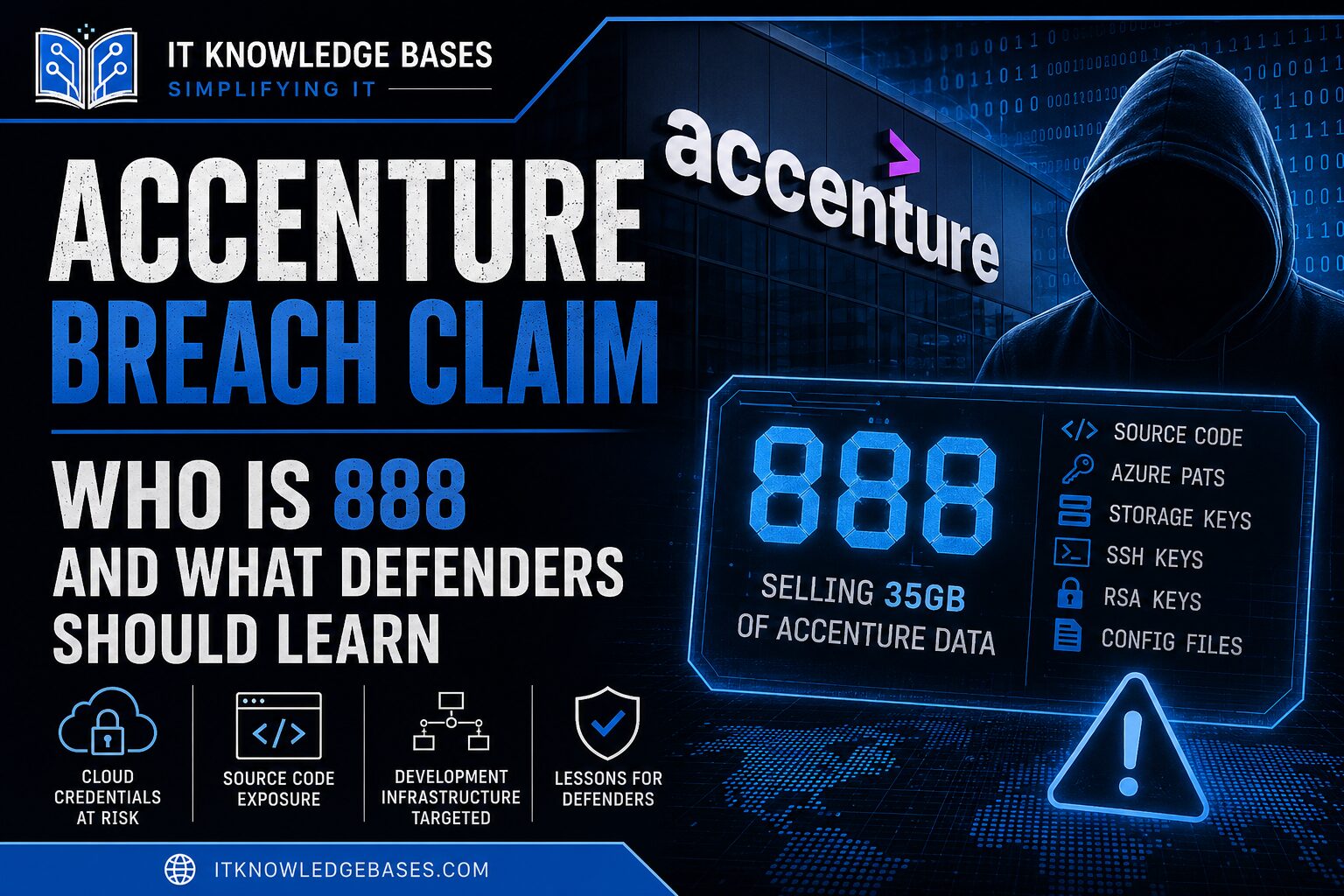
Accenture has confirmed it handled an isolated security incident after a threat actor using the alias 888 claimed to be selling about 35 GB of allegedly stolen company data. Accenture told BleepingComputer that the matter was isolated, the source was remediated, and there was no impact to operations or client service delivery. Accenture has not confirmed the claimed data volume or the full contents of the alleged dataset.
Source: BleepingComputer
What We Know
SOCRadar reported that the breach listing was dated July 6, 2026. The actor claimed the dataset included source code, Azure Personal Access Tokens, Azure Storage access keys, SSH keys, RSA keys, and configuration files.
Source: SOCRadar
BleepingComputer reported that screenshots tied to the claim appeared to show an Azure DevOps repository under an Accenture domain, including a repository named 121123_AtriasTalentAcademy. That supports the possibility that some internal development material was exposed, but it does not independently prove the full 35 GB claim or whether any credentials were still valid.
What Is Still Unverified
At this point, the following should be treated as attacker claims, not confirmed facts:
- The full 35 GB data volume.
- Whether all advertised files are authentic.
- Whether the listed credentials were active.
- Whether customer data was accessed.
- The initial access method.
- Whether the breach involved Accenture directly, a third party, exposed cloud assets, stolen credentials, or another path.
This distinction matters because 888 has previously made Accenture-related claims that Accenture disputed. In June 2024, 888 claimed data on more than 32,000 current and former Accenture employees; Accenture reportedly said the dataset contained only three genuine names and Accenture email addresses.
Source: Help Net Security
Who Is 888?
888 is best understood as a financially motivated data leak and brokerage actor, not a traditional ransomware crew. Public reporting has associated 888 with stolen-data postings, breach claims, and private database sales.
Resecurity has described 888 as a credible dark web data broker associated with large-scale breach claims and stolen-data postings. In one 2025 case, Resecurity linked 888 to the sale of data from Brazil’s CIEE One platform after records were exposed through cloud storage.
Source: Resecurity
The normal motive appears to be financial: acquire or steal valuable data, advertise proof samples, and sell access or datasets through underground channels. There is no strong public evidence that 888 is primarily political, state-directed, or operating like a ransomware-as-a-service group.
Typical TTPs Associated With 888
Based on public reporting, 888’s usual pattern appears to involve:
- Data acquisition or theft: obtaining corporate, employee, customer, cloud, or development-related data.
- Proof posting: sharing screenshots, file lists, or samples to establish credibility.
- Forum-based monetization: advertising stolen datasets for sale on cybercrime forums.
- Credential and source-code interest: emphasizing data that can support follow-on access, resale, or supply-chain risk.
- Limited ransomware overlap: 888 is not mainly known for encrypting systems or operating like LockBit-style ransomware crews.
For the Accenture case, the exact intrusion chain is still unknown. Claims that 888 used a specific vulnerability, phishing campaign, third-party compromise, or cloud misconfiguration should be treated as theory unless forensic details are published.
Why This Breach Claim Matters
The most important part of this claim is not only the alleged source code exposure. The bigger concern is the reported exposure of cloud and development credentials.
If valid Azure PATs, storage keys, SSH keys, or RSA keys were exposed, attackers could potentially use them to:
- Access repositories.
- Pull more internal data.
- Abuse build or deployment pipelines.
- Pivot into cloud resources.
- Search code for additional secrets.
- Attempt downstream supply-chain attacks.
That does not mean those things happened. It means those are the risks defenders should immediately consider when this type of data appears in a breach claim.
Keep This Separate From Accenture’s 2021 LockBit Incident
This should not be confused with Accenture’s 2021 ransomware incident. In 2021, LockBit claimed responsibility and reportedly alleged theft of around 6 TB of data with a $50 million ransom demand. That was a ransomware and double-extortion scenario.
The 2026 claim is different. It is tied to 888 and currently looks more like data theft and resale than ransomware deployment.
Source: Dark Reading
What Defenders Can Learn
This incident is a reminder that development infrastructure should be treated like production infrastructure. Source code, build systems, cloud keys, and internal configuration files can create serious risk even when ransomware is never deployed.
Security teams should focus on:
- Secret scanning across repositories.
- Rapid rotation of PATs, SSH keys, storage keys, certificates, and service credentials.
- Short-lived credentials instead of long-lived standing access.
- Least privilege for developer, service, and CI/CD accounts.
- Monitoring for unusual repository cloning, token usage, and cloud storage access.
- Strong controls around Azure DevOps, GitHub, GitLab, CI/CD runners, and artifact storage.
- Third-party access reviews.
Use Network Mapping to Find Gaps Before an Incident
One practical lesson is that teams need a clear map of where sensitive systems, cloud services, repositories, third-party connections, and administrative access paths exist. If you do not know where your development tools connect to production, where service accounts are used, or which vendors touch sensitive environments, it becomes much harder to respond quickly when credentials or source code are exposed.
The IT Knowledge Bases Network Mapping Tool can help document these relationships before an incident. It is useful for mapping systems, cloud services, access paths, third-party dependencies, and areas where security reviews are missing. A network map will not prevent a breach by itself, but it can make it easier to identify exposure, prioritize remediation, and find gaps before attackers do.
Open the IT Knowledge Bases Network Mapping Tool
Bottom Line
The confirmed fact is limited: Accenture acknowledged and remediated an isolated security incident.
The attacker claim is broader: 888 says they stole and are selling 35 GB of Accenture data, including source code and cloud-related credentials.
The unproven pieces remain important: the full dataset size, exact contents, credential validity, customer impact, and initial access method have not been publicly confirmed.
The right takeaway is not panic. It is disciplined skepticism plus immediate defensive review. Treat attacker claims as unverified, but take any claimed exposure of cloud credentials, source code, and build infrastructure seriously until proven otherwise.