
Most organizations treat IT like a utility—like the plumbing. You only notice it when it leaks. But in the modern enterprise, IT isn’t the plumbing; it’s the central nervous system.
If you want to move from being a “tech person” to a strategic leader, you have to master COBIT (Control Objectives for Information and Related Technologies). COBIT isn’t a checklist; it’s a philosophy of control. For those deep in the CISSP study process, COBIT is the framework that turns technical domains into business results.
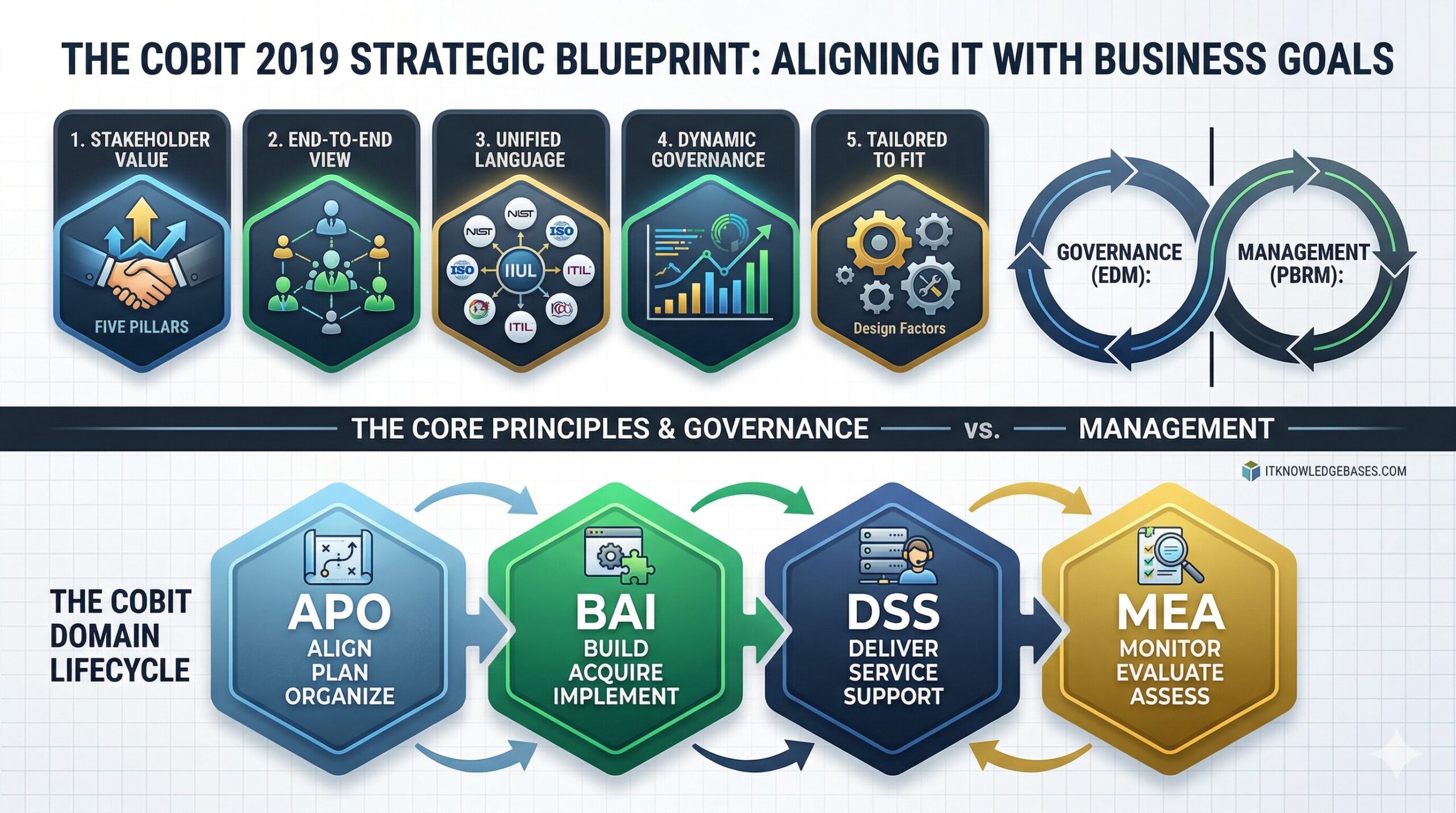
1. The Great Divide: Governance vs. Management
This is the “line in the sand” that separates successful companies from chaotic ones. If you don’t understand this distinction, your governance strategy will fail before it starts.
- Governance (The Boardroom): Their job is to Evaluate, Direct, and Monitor (EDM). They don’t care about the brand of firewall you bought. They care about risk appetite and value creation. They set the destination.
- Management (The Engine Room): Their job is to Plan, Build, Run, and Monitor (PBRM). They take the Board’s direction and turn it into technical reality.
When these two blur, you get “Shadow IT” and wasted millions. Governance says “We need to be secure”; Management decides how to encrypt the data.
2. The Five Pillars of a Sovereign Enterprise
To make COBIT stick, stop looking at it as a book of rules. Start looking at it as a set of non-negotiable principles for any vulnerability research or compliance program:
- Stakeholder Value: If a project doesn’t directly contribute to the business’s bottom line or risk reduction, kill it.
- Holistic View: IT doesn’t live in a silo. If the HR department’s onboarding process is broken, that’s a COBIT failure.
- The Unified Language: Stop juggling ten different frameworks. COBIT aligns NIST, ISO, and ITIL into one conversation.
- Dynamic Governance: A governance system isn’t a statue; it’s a living thing that evolves with the threat landscape.
- Tailored to Fit: A startup doesn’t need the same governance as a global bank. COBIT 2019 uses “Design Factors” to build a suit that actually fits the business body.
3. The COBIT Lifecycle: Turning Strategy into Action
How does this look in practice? It follows a four-stage loop that ensures nothing falls through the cracks—a concept often mirrored in security model classifications.
| Phase | The Strategic Reality |
|---|---|
| APO (Align, Plan, Organize) | The Blueprint. Align IT strategy with business goals or you’re just spending money to stay busy. |
| BAI (Build, Acquire, Implement) | The Factory. Acquiring capabilities and integrating them into the workflow. |
| DSS (Deliver, Service, Support) | The Front Line. This is where the value is actually felt by the user. |
| MEA (Monitor, Evaluate, Assess) | The Mirror. Are we doing what we said we’d do? Find the gaps before the auditors do. |
The Leadership Evolution: From “Tech” to “Governance”
To truly understand the power of COBIT, you have to look at how it changes your daily operations. It moves you from reacting to problems to directing outcomes. Here is what that looks like in the real world:
| Before COBIT (The “Tech” Level) | After COBIT (The “Strategic” Level) |
|---|---|
| Doing: Manually checking if servers are patched because “it’s best practice.” | Asking: “How does our current patch latency align with the risk appetite set by the Board for our financial data?” |
| Doing: Buying a new EDR tool because the old one feels “outdated.” | Asking: “Which ‘Design Factor’ is driving this acquisition? Does it solve a specific BAI (Build/Acquire) gap in our enterprise goals?” |
| Doing: Telling the CEO “We are safe” because the firewall is up. | Asking: “Based on our MEA (Monitor/Evaluate) metrics, here is our 15% reduction in business disruption risk over the last quarter.” |
Mastering the Framework
In the boardroom, no one wants to hear about “patch management.” They want to hear about Fiduciary Responsibility. COBIT gives you the vocabulary to explain technical risk in terms of business impact.
If you are serious about implementing this framework or passing your next high-level certification, you need the right reference material. I highly recommend picking up the COBIT 2019 Framework: Governance and Management Objectives. It is the gold standard for anyone looking to bridge the gap between technical execution and executive leadership.
Check out more technical deep-dives on ITKnowledgebases.com for updates on vulnerability remediation and security intelligence.