
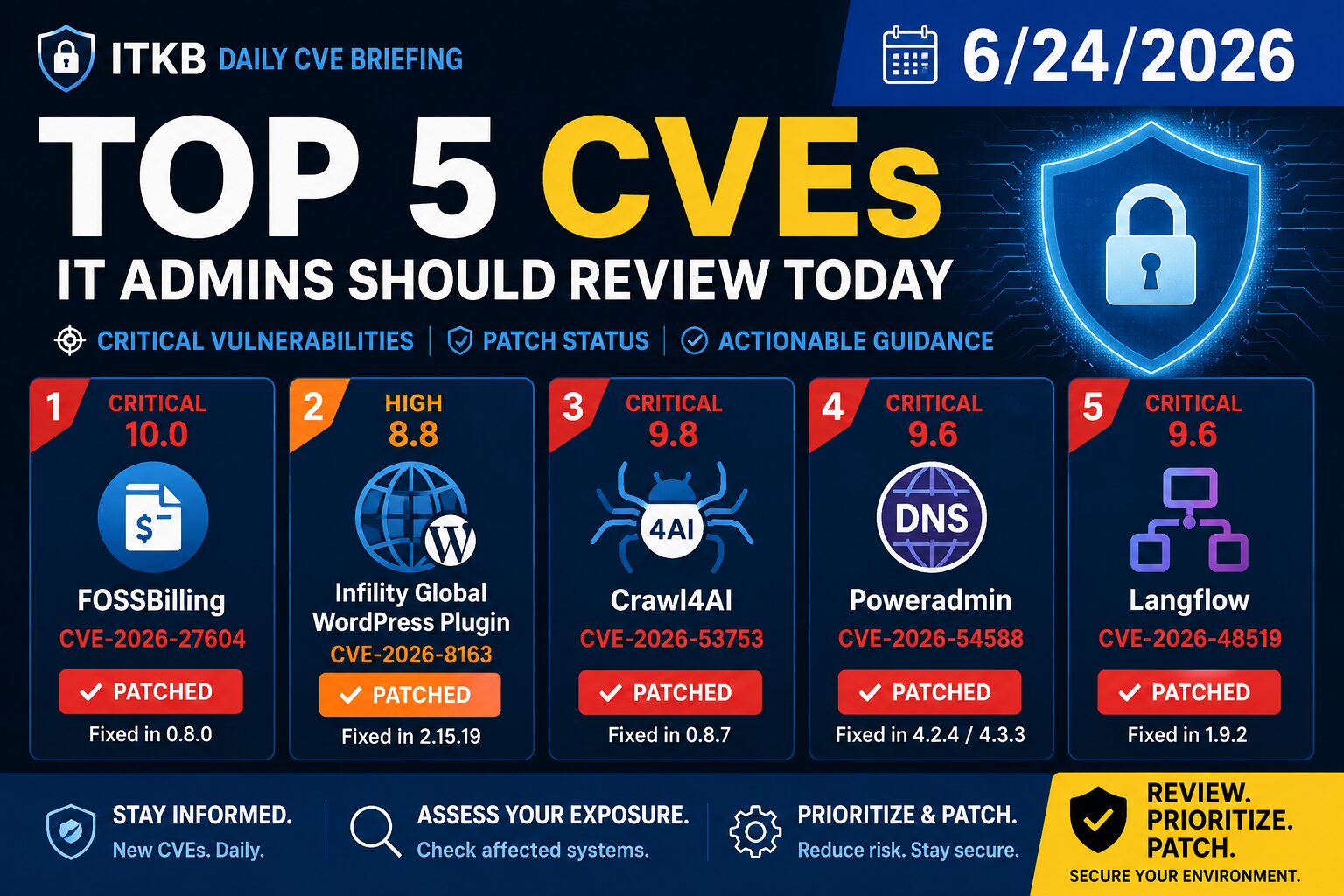
Top 5 CVEs IT Admins Should Review Today — June 24, 2026
Top CVEs are selected based on severity, patch status, affected product clarity, and practical remediation value. Rather than simply listing vulnerabilities, this roundup explains why they matter from both an attacker’s and defender’s perspective so IT administrators can better prioritize remediation efforts.
Feed Updated: June 24, 2026 – 12:00 AM UTC
Important
This post is generated using NVD, CNA, vendor security advisories, and ITKB enrichment. NVD enrichment may lag behind newly published CVEs. Always validate remediation guidance against the official vendor advisory before making production changes.
1. CVE-2026-27604
Severity: Critical (CVSS 10.0)
Affected Product: FOSSBilling
Affected Versions: 0.5.4 through versions before 0.8.0
Fixed Version: 0.8.0
Patch Status: Patched
Verification Status: 🟡 Partially Verified (Vendor/CNA)
Attack Surface
Internet-facing FOSSBilling deployments exposing administrative API functionality.
Who Should Care
- Hosting providers
- MSPs
- Organizations using FOSSBilling
- Organizations exposing billing portals to the Internet
Why Attackers Care
FOSSBilling commonly stores customer accounts, invoices, service information, and administrative configuration. Public advisories indicate this vulnerability allows unauthorized access to privileged API functionality. Successfully abusing privileged API endpoints could allow attackers to perform administrative actions without valid credentials.
Why Defenders Should Care
Billing platforms frequently integrate with customer provisioning systems, hosting platforms, payment workflows, and customer management tools. Unauthorized administrative actions may affect both operations and customer data.
Administrators should investigate unexpected API requests targeting privileged endpoints, unexplained account modifications, newly created administrator accounts, or unusual administrative activity originating from unfamiliar IP addresses.
Recommended Admin Actions
- Upgrade immediately to version 0.8.0 or later.
- Restrict access to
/api/system/*endpoints where possible. - Rotate administrative API tokens.
- Review recent administrative activity.
- Investigate suspicious API requests.
Technical Summary
According to public advisories, versions beginning with 0.5.4 through before 0.8.0 contain an authorization bypass affecting API role handling. The issue may allow unauthenticated access to privileged /api/system/* endpoints. Version 0.8.0 addresses the vulnerability.
2. CVE-2026-8163
Severity: High (CVSS 8.8)
Affected Product: Infility Global WordPress Plugin
Affected Versions: Before 2.15.19
Fixed Version: 2.15.19
Patch Status: Patched
Verification Status: ✅ Verified
Attack Surface
Authenticated WordPress users with Subscriber privileges or higher.
Who Should Care
- WordPress administrators
- Website owners
- MSPs managing WordPress environments
Why Attackers Care
Authenticated SQL injection vulnerabilities may allow attackers to retrieve or modify database information depending on application permissions and database configuration.
Compromising a WordPress site can also create opportunities for follow-on attacks, such as modifying website content, injecting malicious JavaScript, creating phishing pages, or redirecting visitors to attacker-controlled infrastructure.
Why Defenders Should Care
Although exploitation requires an authenticated account, Subscriber accounts are commonly available on membership sites, customer portals, learning platforms, and community websites.
Unexpected database errors, unauthorized website content changes, unusual SQL activity, or suspicious requests originating from low-privileged WordPress accounts may indicate attempted exploitation.
Recommended Admin Actions
- Update to version 2.15.19.
- Review Subscriber-level accounts.
- Remove unused user accounts.
- Review website integrity.
- Monitor database logs for suspicious queries.
Technical Summary
The Infility Global WordPress plugin before version 2.15.19 fails to properly sanitize certain parameters before incorporating them into SQL statements, allowing authenticated SQL injection by users with Subscriber-level privileges or higher.
3. CVE-2026-53753
Severity: Critical (CVSS 9.8)
Affected Product: Crawl4AI
Affected Versions: Before 0.8.7
Fixed Version: 0.8.7
Patch Status: Patched
Verification Status: 🟡 Partially Verified (Vendor/CNA)
Attack Surface
Internet-accessible Crawl4AI deployments.
Who Should Care
- AI platform administrators
- DevOps teams
- Organizations hosting Crawl4AI
- Cloud infrastructure administrators
Why Attackers Care
Public advisories describe this as a remote code execution vulnerability. Remote code execution frequently allows attackers to execute commands using the permissions assigned to the application.
Where Crawl4AI has access to internal APIs, cloud services, databases, or automation workflows, successful compromise may expose resources beyond the application itself.
Why Defenders Should Care
Administrators should review deployments that are directly accessible from the Internet, especially where authentication is disabled or the application has elevated permissions.
Unexpected process creation, unusual outbound network connections, suspicious API requests, or unexplained workflow execution should be investigated.
Recommended Admin Actions
- Upgrade immediately.
- Restrict Internet exposure.
- Enable authentication where available.
- Monitor API activity.
- Review application logs.
Technical Summary
Public advisories describe an AST validation weakness within Crawl4AI’s computed field functionality that may allow arbitrary code execution through crafted requests. Version 0.8.7 addresses the issue.
4. CVE-2026-54588
Severity: Critical (CVSS 9.6)
Affected Product: Poweradmin
Affected Versions: Before 4.2.4 and before 4.3.3
Fixed Versions: 4.2.4 / 4.3.3
Patch Status: Patched
Verification Status: 🟡 Partially Verified (Vendor/CNA)
Attack Surface
Poweradmin authentication interfaces using OIDC or SAML.
Who Should Care
- DNS administrators
- Enterprise infrastructure teams
- Organizations using PowerDNS
- Identity administrators
Why Attackers Care
DNS administration systems are attractive targets because administrative access can allow attackers to modify DNS records, redirect users, interfere with email delivery, or support broader phishing campaigns.
Public advisories indicate this vulnerability may allow manipulation of authentication callback destinations, potentially resulting in account compromise.
Why Defenders Should Care
Unexpected DNS changes often have organization-wide impact. Administrators should review authentication events, monitor DNS record modifications, and verify identity provider configuration for unauthorized changes.
Recommended Admin Actions
- Upgrade to a patched release.
- Validate reverse proxy configuration.
- Review OIDC and SAML configuration.
- Audit DNS changes.
- Review authentication logs.
Technical Summary
According to public advisories, affected versions improperly trust attacker-controlled HTTP_HOST values when generating authentication callback URLs. This may allow an attacker to manipulate authentication flows and compromise administrative accounts.
5. CVE-2026-48519
Severity: Critical (CVSS 9.6)
Affected Product: Langflow
Affected Versions: Before 1.9.2
Fixed Version: 1.9.2
Patch Status: Patched
Verification Status: ⚪ Limited Public Details Available
Attack Surface
Publicly accessible Langflow deployments exposing public workflow functionality.
Who Should Care
- AI administrators
- DevOps teams
- Organizations deploying Langflow
- Cloud platform administrators
Why Attackers Care
Public reporting identifies this as a critical vulnerability affecting Langflow’s public workflow functionality. Systems exposing AI workflows may also provide access to API credentials, automation logic, connected services, or other sensitive resources depending on deployment.
Why Defenders Should Care
At the time of publication, publicly available technical information remains limited. Organizations should treat the assigned severity seriously, prioritize patching, and continue monitoring official advisories as additional information becomes available.
Administrators should review internet-facing deployments, public workflow exposure, and access controls protecting Langflow environments.
Recommended Admin Actions
- Upgrade to version 1.9.2.
- Review public workflow configuration.
- Restrict unnecessary Internet exposure.
- Audit stored credentials.
- Continue monitoring vendor advisories.
Technical Summary
This CVE has been assigned and public advisories indicate a critical vulnerability affecting Langflow prior to version 1.9.2. Public technical details remain limited at the time of publication. Administrators should follow vendor guidance as additional information becomes available.
Final Recommendations
Organizations should prioritize systems that are:
- Internet-facing
- Exposing administrative interfaces
- Running vulnerable versions of FOSSBilling, Crawl4AI, Poweradmin, Langflow, or the Infility Global WordPress plugin
- Accessible by untrusted users
- Integrated with identity providers, payment systems, or production infrastructure
Critical vulnerabilities do not always result in active exploitation, but they should be reviewed promptly to determine exposure within your environment.
Source and Review Notes
This article is intended to support vulnerability triage and operational awareness. Information was reviewed against public CVE records, NVD where available, CNA disclosures, and vendor security advisories. Where authoritative public details remain limited, the article explicitly notes the reduced verification status rather than speculating on technical impact.
For the latest vulnerabilities and enrichment updates, visit the ITKB Advisories page.